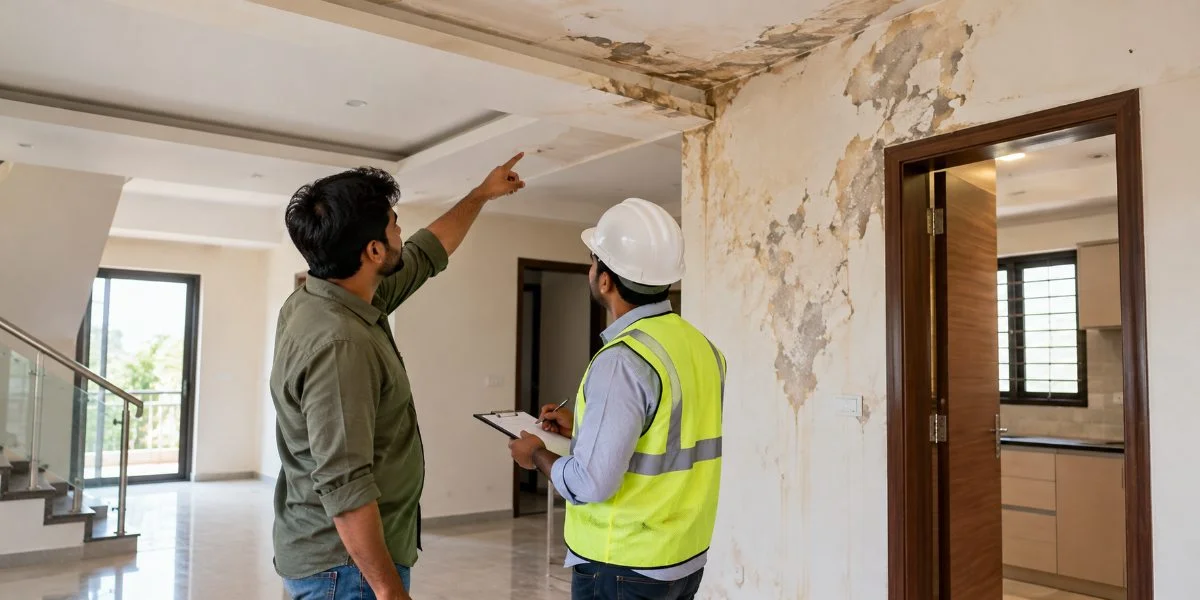
It rarely starts dramatically. A faint tide mark appears near a bedroom ceiling in the first week of heavy rain, dries out by December, and returns slightly larger the following June. Home waterproofing in Bangalore is one of those jobs almost everyone postpones until the paint starts flaking or a neighbour complains. Inspira Home Designs understands the importance of identifying and addressing waterproofing issues early.
The city’s rainfall pattern makes this worse than people expect. Two distinct wet seasons, intense short bursts that overwhelm drainage, and long humid spells where nothing dries properly between showers. Small defects get tested repeatedly, and eventually they fail. Inspira Home Designs helps homeowners plan practical solutions to protect their properties from moisture damage.
Most leaks aren’t caused by bad materials. They come from poor detailing at junctions, and from treatments applied in the wrong conditions.
Flat RCC terraces are the usual culprit. They expand and contract through the day, and that movement concentrates at parapet junctions, drain mouths and pipe penetrations. A membrane rolled neatly across the middle of the slab but stopped short at the parapet will leak within two seasons, whatever the product cost.
The second cause is weather. Membranes need a dry, clean substrate and proper curing time. Work rushed in early June over damp concrete, because the owner wanted it done before the rain, blisters and debonds. That’s why experienced waterproofing services Bangalore firms push these jobs into the December to April window.
Ponding water is the giveaway. If puddles still sit on the terrace two hours after rain stops, the slope is inadequate and the drain mouths are too high or blocked. Standing water finds every hairline crack. Roof waterproofing Bangalore buildings need almost always starts with correcting falls using a screed, not with applying a coating over the existing surface.
Seepage into the room below usually traces to a failed bathroom membrane or a leaking concealed joint. The tell is a damp patch on the ceiling directly under the shower or WC, worst in the mornings. Patching from below does nothing. The fix is above, and it means opening the bathroom floor. This is the part of home waterproofing in Bangalore owners most often try to avoid.
Bengaluru’s driving rain hits the western and southern faces hardest. Water enters through cracked plaster, unsealed window frames, and gaps where AC copper lines pass through. Inside, it shows as a damp band near the ceiling or around the window reveal. Sealing the frame perimeter, applying an elastomeric exterior coating and fixing plaster cracks usually resolves it without touching the interior. The roof waterproofing Bangalore owners pay for won’t help at all if the walls are the entry point.
Older independent houses with basements or sunken car parks face groundwater pressure during the monsoon, especially in low-lying parts of the city. That needs negative-side treatment, crystalline additives and sometimes a sump, so get it specified by a house waterproofing Bangalore specialist rather than improvised on site.
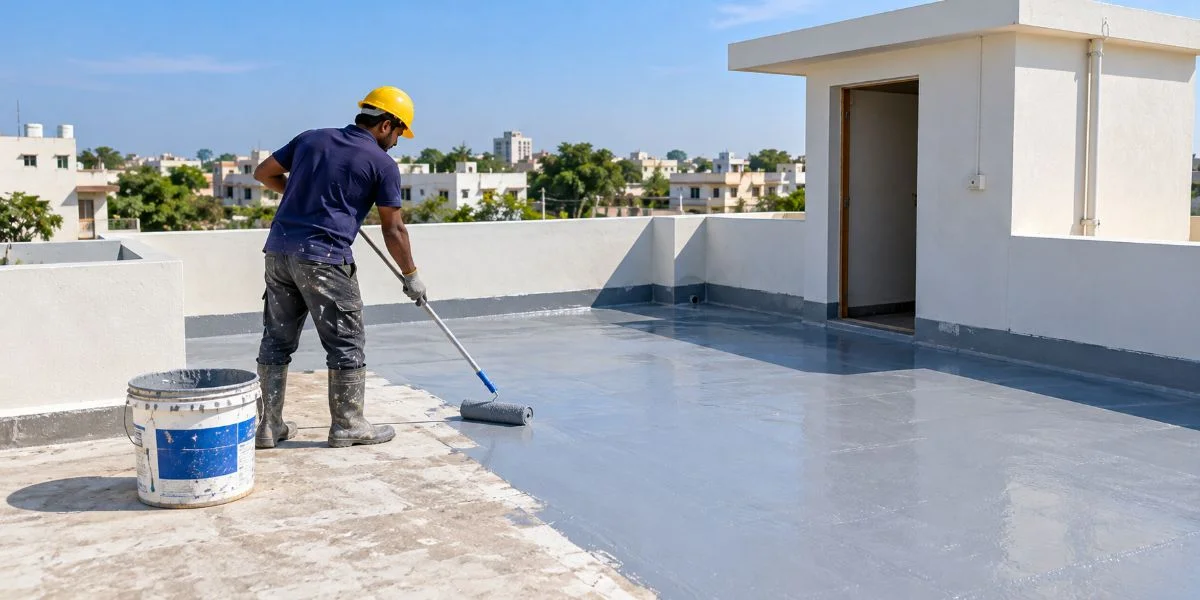
The sequence below is what proper terrace waterproofing Bangalore buildings need looks like. Skip a step and you shorten the life of everything above it.
1. Remove the old failed layer rather than coating over it
2. Repair cracks, and grout any active leak points
3. Form coved fillets at every parapet and column junction
4. Lay a screed to correct the fall toward drain mouths
5. Apply the membrane in the specified number of coats, extending up the parapet
6. Treat drain mouths and pipe penetrations with extra reinforcement
7. Pond-test for 24 to 48 hours before laying any protective tile or screed
That ponding test is the step most often dropped, and it’s the only proof you get before the surface is covered. Insist on it, and be there when it’s filled and drained.
|
System |
Indicative ₹ per sq ft |
Typical life |
Best suited to |
|
Acrylic / cementitious coating |
45 – 90 |
4 to 6 years |
Low-traffic terraces, budget work |
|
Polyurethane (PU) coating |
110 – 200 |
8 to 12 years |
Exposed terraces with movement |
|
APP / bituminous membrane |
90 – 160 |
8 to 12 years |
Large terraces, under protective screed |
|
Crystalline / integral treatment |
60 – 120 |
Long, if applied correctly |
Basements, water tanks, sunken slabs |
|
Brick bat coba with screed |
100 – 180 |
10 to 15 years |
Traditional terraces, good thermal benefit |
None of these is universally best, and any waterproofing services Bangalore firm claiming otherwise is selling one product. PU handles thermal movement well but degrades under permanent standing water. Bituminous membranes are strong but need careful lap sealing and a protective layer above. Brick bat coba stays popular in independent houses because it also cuts heat gain, though it adds dead load.
Ranges for home waterproofing in Bangalore below are indicative 2026 planning figures. They shift with system choice, access difficulty and how much repair the surface needs first.
• Terrace treatment for a 1,000 sq ft roof: roughly ₹70,000 to ₹2 lakh depending on system
• Single bathroom, full membrane after strip-out: ₹18,000 to ₹45,000
• External wall coating for an independent house: ₹40,000 to ₹1.2 lakh, plus scaffolding
• Basement treatment: highly variable, priced after inspection
Access is the hidden cost. Scaffolding for a three-storey elevation, or rope access where scaffolding won’t fit, can add a meaningful amount. Most house waterproofing Bangalore quotes exclude it unless you ask.
This trade has more than its share of quick jobs that look fine for one season. A few questions separate the serious firms.
• Which specific product and system are you proposing, and at what coating thickness?
• How many coats, and what’s the curing time between them?
• Will you correct the slope, or only coat the existing surface?
• Do you carry out a ponding test before covering the work?
• What warranty is offered, and does it cover materials and labour together?
Ask for a written warranty of at least five years on terrace work, from a firm that has been around long enough to honour it. Reputable waterproofing contractors Bangalore residents recommend also photograph each stage, which matters because you can’t inspect a membrane once it’s covered.
Schedule home waterproofing in Bangalore between December and April. Application needs consecutive dry days, and the surface must be genuinely dry, not merely rain-free that morning.
After that, maintenance is mostly about drainage. Clear terrace drain mouths before each monsoon, trim overhanging branches that drop leaves onto the roof, and check parapet junctions once a year for hairline cracks. Watch the ceiling of the top-floor rooms during the first heavy rain each season. Catching a small defect in year four is inexpensive; discovering it in year seven, after water has been sitting in the slab, is not.
It depends on the system and the detailing. A cementitious coating typically gives four to six years, polyurethane and bituminous membranes eight to twelve, and a well-laid brick bat coba terrace can pass fifteen. Poor junction detailing or standing water shortens all of these considerably, regardless of the product used.
Emergency crack sealing and some injection work can be done in wet conditions, but full membrane application cannot. The substrate has to be dry and needs uninterrupted curing time. Work forced through in the rain tends to blister and debond, which means paying twice within a couple of years.
Usually because the treatment stopped at the flat area and never reached the parapet junction, the drain mouth or the pipe penetration. Those three details cause most repeat leaks. It can also mean the water is entering elsewhere and travelling along the slab before appearing at the weakest point.
No. Tiles are a protective and thermal layer, not a barrier. Water passes through grout joints readily. Tiles laid directly over a bare slab without a membrane below will not stop seepage, and they make future diagnosis harder because the source becomes difficult to locate.
Leaks are almost always a detailing problem dressed up as a product problem. The terraces that stay dry are the ones where the old layer was stripped, the falls were corrected, the junctions were coved and reinforced, and somebody insisted on a ponding test before anything was covered. Home waterproofing in Bangalore works when it’s planned for the dry months and executed slowly, and it fails when it’s rushed against the first showers of June. Budget for the system your roof actually needs, keep the drains clear, and inspect once a year rather than waiting for a stain. Inspira Home Designs helps homeowners plan waterproofing solutions suited to their building’s needs.
If you’re weighing up your options, Contact Inspira Home Designs for answers matched to your building and its condition.
Follow us on Instagram for our latest home design projects, interior transformations, creative layouts, and ideas for beautiful living spaces.